Forest Studio Edu
An Introduction to the Forest Studio Model and App
2025-11-19
What is Forest Studio Edu?
Forest Studio Edu is a comprehensive forest management simulation platform that enables:
- Data-driven forestry decisions
- Scenario modeling and analysis
- Sustainable forest management planning
- Interactive visualization and simulation tools
Forest Studio VS Forest Studio Edu
Forest Studio Edu combines a landscape simulation model-Forest Studio with an interactive application.
- The model simulates forest dynamics, and management.
- The app provides an intuitive interface to run simulations, explore scenarios, and visualize results.
💡 The model can run independently, but the app depends on the model to operate.
Key Features of Forest Studio Model
- Growth module: tree species specific, competition and size dependent
- Mortality module: tree species specific, competition (relBAI and BA) and size dependent
- Regeneration module: species specific, light and seed-tree dependent
- Management module: at management unit and tree specific
- Economic assessment module
- User-friendly app
Future Developments
- Climate-sensitive modules: Growth, mortality & regeneration
- Enhanced recruitment: Trees <10cm and improved dynamics
- Species expansion: New species parameterized
- Disturbances
🌲 Species Parameterized (24)
Conifers
- Abies alba — Silver fir
- Larix decidua — European larch
- Picea abies — Norway spruce
- Pinus mugo — Mountain pine
- Pinus sylvestris — Scots pine
- Taxus baccata — Yew
Broadleaves
- Fagus sylvatica — European beech
- Quercus robur / Quercus spp. — Oaks
- Carpinus betulus — Hornbeam
- Fraxinus excelsior — Ash
- Other broadleaves: Prunus avium, Corylus avellana, Salix spp., Sorbus aria, Sorbus aucuparia, Tilia cordata, Ulmus glabra, Alnus glutinosa, Alnus incana, Betula spp., Acer campestre, Acer platanoides, Acer pseudoplatanus
Spatial considerations
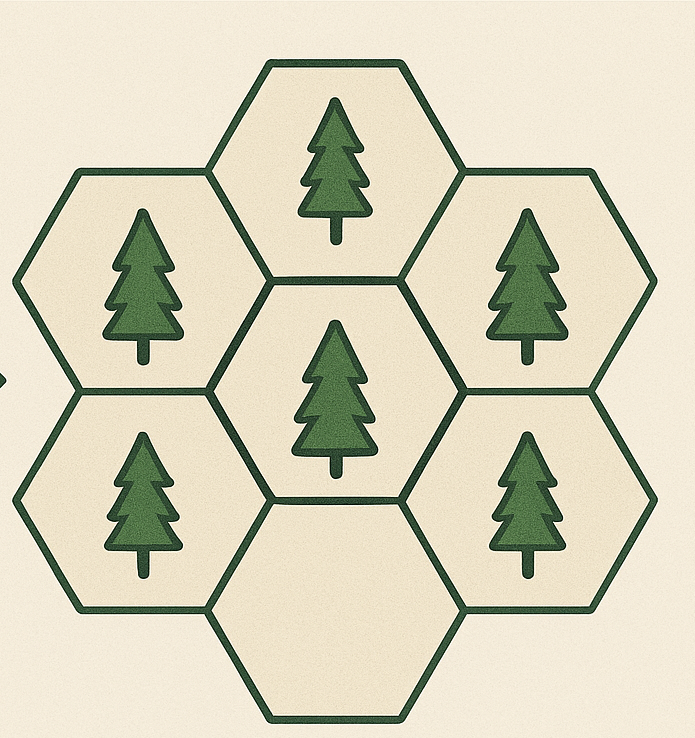
- Hexagonal grid of 75 m²
- Random distribution of trees within the MU hexagons
- Competition within and between hexagons (growth, mortality and regeneration)
Modules pipeline
Start of year n
\(N_{trees}\)
Mortality
\(N_{trees}-N_{dead}\)
Regeneration
\(N_{trees}+N_{regen}\)
Harvest
\(N_{trees}-N_{harv}\)(thinning / clearcut)
Planting
(post-clearcut only)\(N_{plant}\)
Economic Assessment
\(N_{harv}\)
::::::::::
Management Module
(1) Thinning (MU)
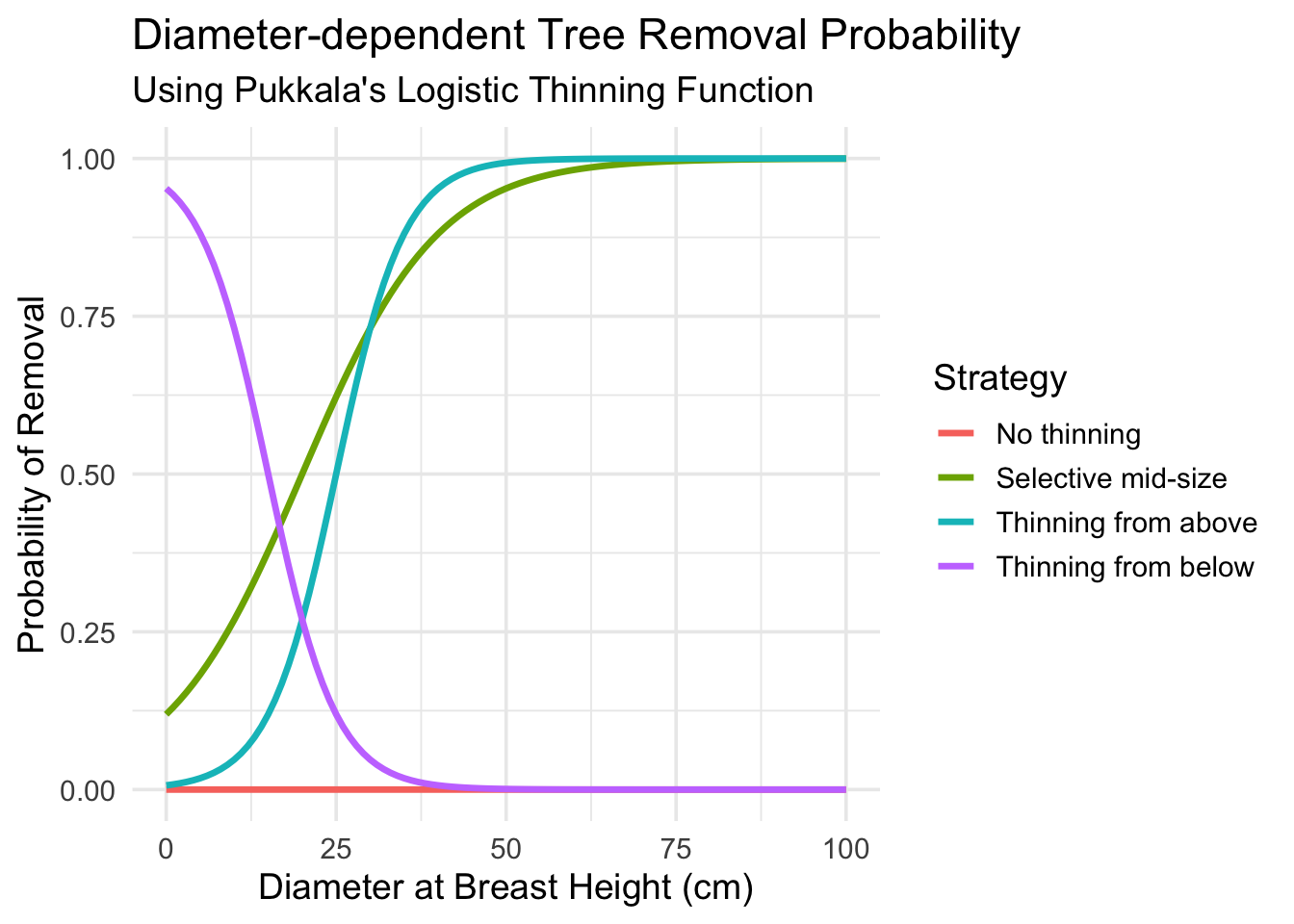
Logistic curve defined by two parameters (a and b) ![]()
(2) Constraints
Target basal area (MU)
BAMU ≥ BAmin
Large wood proportion (species-specific)
DBH ≥ 50 cm ≥ threshold
Target diameter (species-specific)
DBHspp ≥ DBH ⇒ removal probability = 1
Harvest intensity (MU)
BA removal ∈ [min, max] %
Spruce dominated - All (8MU)
Constraints
- Target basal area min: BA_MU ≥
BA_min = 20m2/ha
- Large wood proportion: DBH ≥ 50 cm ≥
threshold=0
- Target diameter: DBH_spruce ≥
DBH=35 ⇒ removal probability = 1 (aalb=45, ldec=45, psyl=45, Rest 0!)
- Harvest intensity: BA removal ∈ [
min=0.2, max=0.4] %
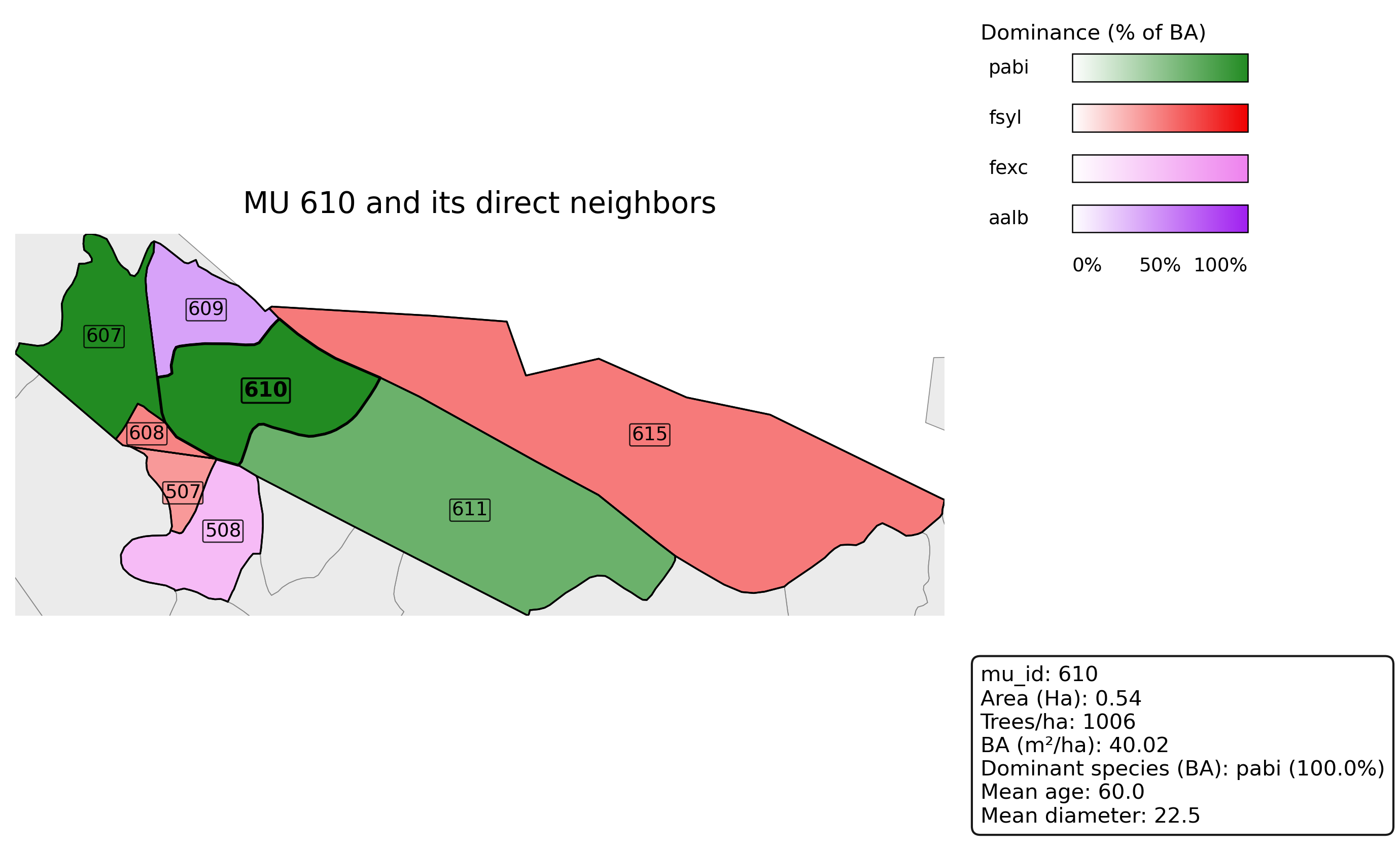
Spruce-MU 610- Characterization
![]()
Spruce-MU 610- Dynamics
![]() Dense spruce stand (yield table ≈ 300 trees/ha at 80 years).
Dense spruce stand (yield table ≈ 300 trees/ha at 80 years).
Thinning yield tables: 16.0–8.8 m²/ha.

 Dense spruce stand (yield table ≈ 300 trees/ha at 80 years).
